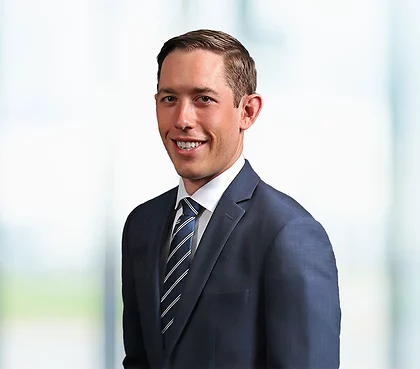
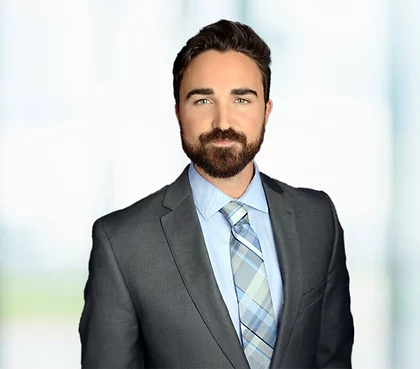
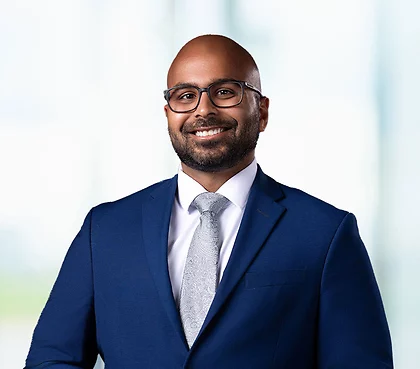
On January 1, 2026, Robins Kaplan welcomed Marcus Guith, Sean O'Connor, and Raoul Shah as partners—a milestone that recognizes not only their exceptional legal work, but their dedication to clients, colleagues, and the communities they serve.
Marcus has built a strong business litigation practice focused on complex product liability and healthcare disputes. Sean has established himself as a trusted advisor in high-stakes insurance and catastrophic loss matters, representing clients across the country. And Raoul has dedicated his career to advocating for injured individuals and families, while maintaining a deep commitment to pro bono service and community leadership.
We sat down with all three to learn more about what drives their work, the experiences that have shaped them, and what they're looking forward to as partners at the firm.
What are you most excited to do or build as a partner?
MG: I’m excited to build out two specific practice areas within our Business Litigation Department. We’ve recently gotten some terrific trial wins both in our product liability and healthcare practices, and it feels like we’re just scratching the surface.
SO: I am most excited to continue building a practice that helps clients navigate their most complex catastrophic loss claims and disputes with clarity and efficiency. As a partner, I will focus on mentorship and on expanding the ways we add value to the insurance and reinsurance markets through thoughtful strategy, responsiveness, and practical judgment.
RS: First and foremost, I’m excited to continue serving injured individuals and families and guide and assist them in their pursuit of justice. Beyond that, I am looking forward to continuing to mentor others, furthering my pro bono and community service work, and making larger scale and firm-wide contributions in all areas.
What experience has most shaped how you approach your work today?
MG: One of the most formative experiences of my career was our significant trial victory in a complex product liability case involving a propane-powered forklift that exploded at a tissue mill, causing extensive property damage and business disruption. Over four years of litigation, we navigated robust discovery, more than fifty depositions, and numerous pre-trial motions, culminating in an eight-week jury trial and a $73 million jury verdict. It was an excellent example of a team coming together under significant pressure and delivering exceptional results. I’ll be chasing another win like this for a long time!
SO: Working on high-stakes matters early in my career showed me how much value comes from a clear strategy and decisive action. Today, I focus on early alignment, sound judgment, and providing straightforward advice clients can act on with confidence.
RS: I started my career as a child protection attorney and criminal prosecutor. From those roles, I learned very early on that, even though we have to follow the law, we can’t take a “one size fits all” approach. Every client and every case is different and, as an attorney whose job is to serve, I need to meet each client where they’re at. That’s something I really value and strive to incorporate in my daily work and life.
What do you enjoy most about the work you do?
MG: I particularly enjoy setting and executing on case strategy in litigation. It is very rewarding to develop key case themes early in a matter and see them play out through discovery and, eventually, in front of the jury.
SO: I enjoy tackling difficult coverage questions, giving clients clear counsel early, and then defending those decisions when disputes arise. My work is national in scope, and I enjoy building strategies that are consistent in principle while adapting to the facts, venue, and governing law of each matter.
RS: Helping people. As lawyers, we mostly hear from people and get cases when something has gone wrong – and as a personal injury/medical malpractice lawyer, when someone has been seriously injured or lost a loved one. I enjoy being able to use my knowledge and skills to guide clients through the system, break down barriers, and achieve some level of justice and closure. While I can’t fix what happened, my number one goal is to do what I can to ease the process and make things at least a little bit better, however I can.
What’s one thing people might not know about your practice?
MG: A significant portion of my practice relates to large industrial disasters, with an emphasis on fires and explosions. I have experience representing both individual plaintiffs and large corporations in these types of cases and particularly enjoy piecing together the evidence to explain how the incident occurred and why.
SO: People are sometimes surprised that, despite our high-stakes litigation work, a significant part of my practice is advisory. We provide coverage counsel and strategic guidance that helps clients evaluate risk and make decisions proactively, often before any dispute arises.
RS: People tend to think of personal injury-type lawyers as “ambulance chasers,” and we’re really not. As much as we love our jobs, I think most if not all of us wish nobody ever needed to hire us – because that would mean people aren’t getting hurt anymore. At the end of the day, while there’s plenty of law and procedure in this practice, it really boils down to the fundamentals of humanity. As the lawyer, you get to play many roles – the advocate, the counselor, the analyst, the student, the teacher, and so much more. And the general public tends to think lawyers are just inherently smart, but one of the best parts of my practice is I’m learning something new every hour of every day.
What’s something outside the courtroom that influences how you show up as a lawyer or teammate?
MG: I’m a pretty enthusiastic and dedicated cyclist. I’m always looking for ways to improve my performance on the bike, and I think the discipline and self-motivation needed to do this translates very well to the courtroom.
SO: I take health and recovery seriously because they are the foundation for steady judgment and consistency under pressure. That discipline helps me stay grounded, prepared, and reliable when the stakes are at their highest.
RS: I play trumpet in a brass band and was in marching bands through college. There’s a lot of practice involved in being a musician and being a lawyer is very similar – details matter, and there’s always ways to improve your craft. And you really learn to trust and empower your teams when playing in a band – everyone has a part and the group succeeds or fails together – but you have to trust your team and come together as a unit for the biggest successes.
Related Attorneys
 Partner
 Partner
 Partner
